Bahamian hutia in Exuma Park: where it lives, what it eats and how it is protected
The Bahamian hutia is the only land mammal native to The Bahamas. Where it lives, the Warderick Wells transplant, its conservation status and park pet rules.
The Bahamian hutia is a rabbit-sized, nocturnal rodent1 and the only land mammal native to The Bahamas2. A small population was transplanted to Warderick Wells, the Exuma Cays Land & Sea Park's headquarters island, and to Little Wax Cay2. BNT described it as endangered in 1995; a 2019 study lists it as vulnerable2,3.
- At a glance
- Activity
- Nocturnal, underground by day1
- Native range
- Only land mammal native to The Bahamas2
- Transplanted to
- Little Wax Cay and Warderick Wells2
- Status, BNT 1995
- Endangered2
- Status, 2019 study
- Vulnerable3
On this page
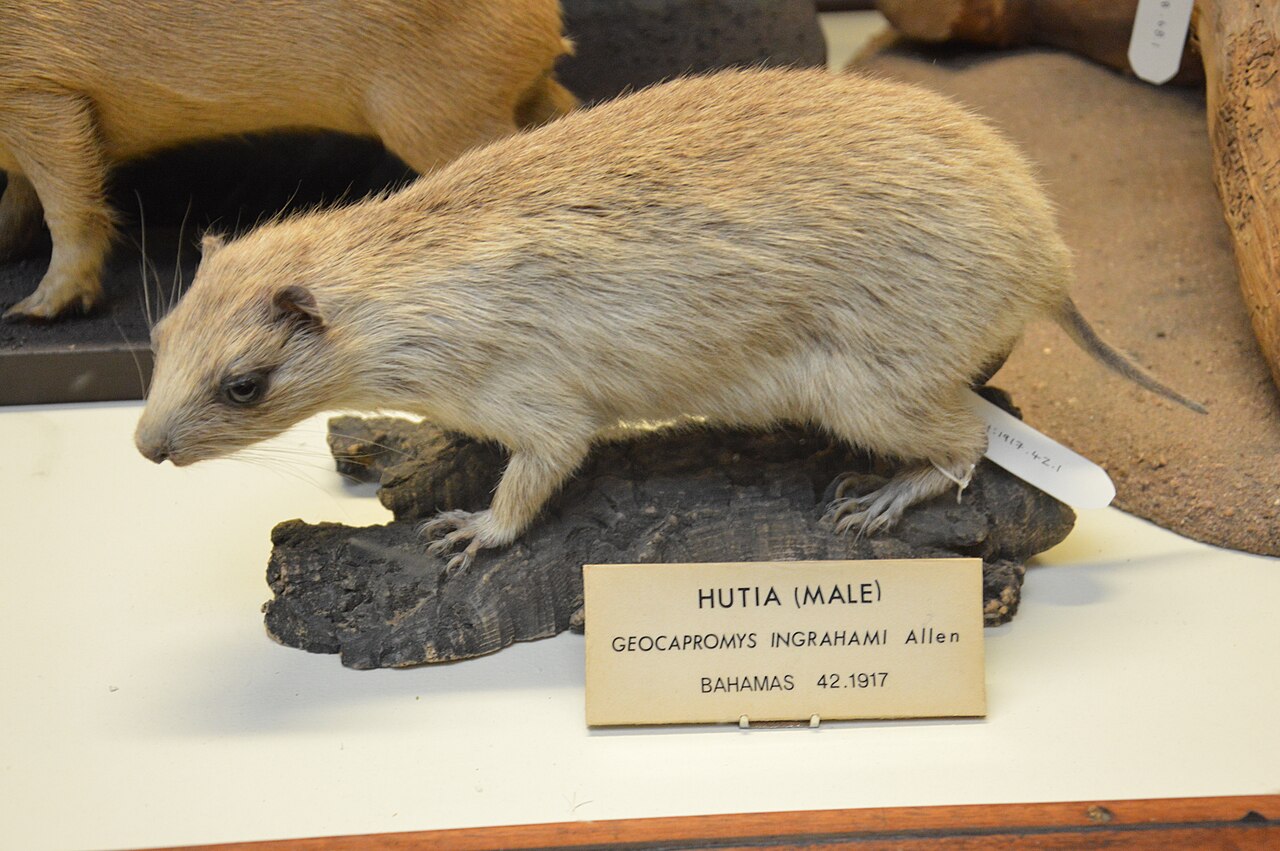
The Bahamian hutia is the one native land mammal in the Bahamian islands, and it lives on the land of the Exuma Cays Land & Sea Park. The park’s land is a vital refuge for a small mammal called the hutia, several rare iguana species and marine birds such as terns and white-tailed tropicbirds6. This page covers the animal, its range, its status and the rules that protect it. For the rest of the park’s animals, see the wildlife guide.
What is the Bahamian hutia?
About the size of a rabbit, the hutia lives in burrows in forests or shrubland and emerges at night to feed on leaves, fruit and other plant matter1. Hutias are nocturnal and are the only land mammal native to The Bahamas2. A 2019 study calls Bahamian hutias the only endemic terrestrial mammal in The Bahamas3.
The Animal Diversity Web gives an average adult mass of 660 g and calls the species a “living fossil” because it was once thought to be extinct4. It was believed to be extinct until 1966, when biologist Garrett Clough found a relict population on East Plana Cay, a small, uninhabited strip of land east of Long Island1. Clough described the Bahamian hutia as “a most peaceable rodent”1.
Where do Bahamian hutias live?
Once widespread across the Bahama archipelago, hutias are now limited to one ostensibly natural population on East Plana Cay and two modern-introduced populations on Little Wax Cay and Warderick Wells3. BNT’s fact sheet says a small hutia population was transplanted to two locations, Little Wax Cay and Warderick Wells2.
The 2019 study dates the Little Wax Cay introduction to 1973. In that year, conservation efforts by the Bahamas National Trust led to the translocation of six male and five female hutias from East Plana Cay to Little Wax Cay3.
Warderick Wells is the island where the park has its headquarters. See the Warderick Wells headquarters page for how to reach the park office. A program is also reintroducing the hutia to the island of Exuma4.
Is the Bahamian hutia endangered?
Status depends on the source and the year. BNT’s fact sheet, copyright 1995, calls the hutia endangered, although current populations are thriving2. A 2019 study by LeFebvre and colleagues says hutias are currently classified as a vulnerable species3.
Its population, though small, is believed to be steady, but a hurricane or the arrival of predators such as feral cats could threaten it1. The Animal Diversity Web lists hunting, habitat destruction and predation by introduced cats, dogs and mongoose among the causes of endangerment4. The 2019 study says hutia populations depend on a delicate balance of resources, no human predation or disturbance, and ecological stability that natural events can upset3.
What do hutias eat, and when are they active?
Hutias are considered nocturnal folivores, preferring to forage at dusk and spending the day in rocky crevices or silver palm leaf piles3. A hutia can climb trees but mostly forages on or close to the ground, feeding on leaves, shoots, fruit, nuts and bark and occasionally on insects or small lizards1. By day it stays underground1.
How do hutias breed and how long do they live?
A female may have one to four young4. The young are born full of fur and with their eyes open, and they tend to stay with their mothers for up to two years4. The species lives up to 12 years in the wild, and its reproduction rate is low4.
What protects hutias in Exuma Park?
The hutia is protected under the Wild Animals (Protection) Act2.
Pets are restricted to beaches only. No pets are permitted on trails or in the brush5.
The park’s rules say that over the years pets have caused the destruction of bird nesting sites, the loss of rare or endangered species (rock iguanas and hutia), and the disturbance of native vegetation5. Read the park rules before you bring a dog ashore, and see the rock iguana guide and the Nassau grouper guide for the other protected animals in the park.
Read next
Wildlife in Exuma Park: hutia, iguanas, seabirds and what you can see
The wildlife of Exuma Cays Land & Sea Park: the Bahama hutia, rock iguanas, nesting seabirds, turtles and fish, plus the park rules that protect them.
parkBahamian rock iguanas in Exuma Park: the species, the Exuma Island iguana and their status
Are there iguanas in the Exumas? The northern Bahamian rock iguana and its Exuma Island and Allen's Cay subspecies: status by level, threats, diet, rules.
parkNassau grouper in the Exumas: closed season, status and the Exuma Park no-take rule
Can you fish for Nassau grouper in Exuma Park? No: the park is no-take all year. The December to February closed season, spawning, size and conservation status.
Questions people ask
What do hutias eat?
Bahamian hutias feed on leaves, shoots, fruit, nuts and bark, and occasionally on insects or small lizards1. They can climb trees but mostly forage on or close to the ground, and they forage at dusk1,3.
Where do hutias live?
A 2019 study says Bahamian hutias are now limited to one natural population on East Plana Cay and two introduced populations, on Little Wax Cay and Warderick Wells3. The Warderick Wells population lives on the headquarters island of the Exuma Cays Land & Sea Park.
How big is a hutia?
A Bahamian hutia is about the size of a rabbit1. The Animal Diversity Web gives an average adult mass of 660 g4.
Sources (6)
- Bahamian hutia
Wikipedia · en.wikipedia.org · checked 2026-10-19 - Bahama hutia (BNT fact sheet, copyright 1995)BNT
Bahamas National Trust · bnt.bs · checked 2026-10-18 - The zooarchaeology and isotopic ecology of the Bahamian hutia (LeFebvre et al., 2019)
PLOS ONE (via PubMed Central) · pmc.ncbi.nlm.nih.gov · checked 2026-10-19 - Geocapromys ingrahami
University of Michigan Museum of Zoology (Animal Diversity Web) · animaldiversity.org · checked 2026-10-19 - Exuma Cays Land and Sea Park Rules (PDF)BNT
Bahamas National Trust · bnt.bs · checked 2026-10-18 - Exuma Cays Land & Sea Park (The Nature Conservancy)
The Nature Conservancy · nature.org · checked 2026-10-18
Photo credits (1)
- Illustratedjc / Wikimedia Commons · CC BY-SA 4.0 · source

Park fees and rules come from the Bahamas National Trust or the Bahamas government; check them again before you go. How we check facts.