Wildlife in Exuma Park: hutia, iguanas, seabirds and what you can see
The wildlife of Exuma Cays Land & Sea Park: the Bahama hutia, rock iguanas, nesting seabirds, turtles and fish, plus the park rules that protect them.
Exuma Cays Land & Sea Park shelters the Bahama hutia, rare rock iguanas, nesting seabirds, turtles and fish1,2,3. The hutia is the only land mammal native to The Bahamas, and it was transplanted to Little Wax Cay and Warderick Wells1. Pets are limited to beaches, and fishing and removing anything are banned6.
- At a glance
- Hutia
- Only native land mammal, nocturnal1
- Hutia sites
- Little Wax Cay, Warderick Wells1
- Iguanas
- Rock iguanas on several Exuma islands4
- Seabirds
- Tropicbirds, noddies, 6 tern species4
- Pets
- Beaches only, 6 ft leash6
- Report poaching
- VHF 09, "Exuma Park"2
On this page
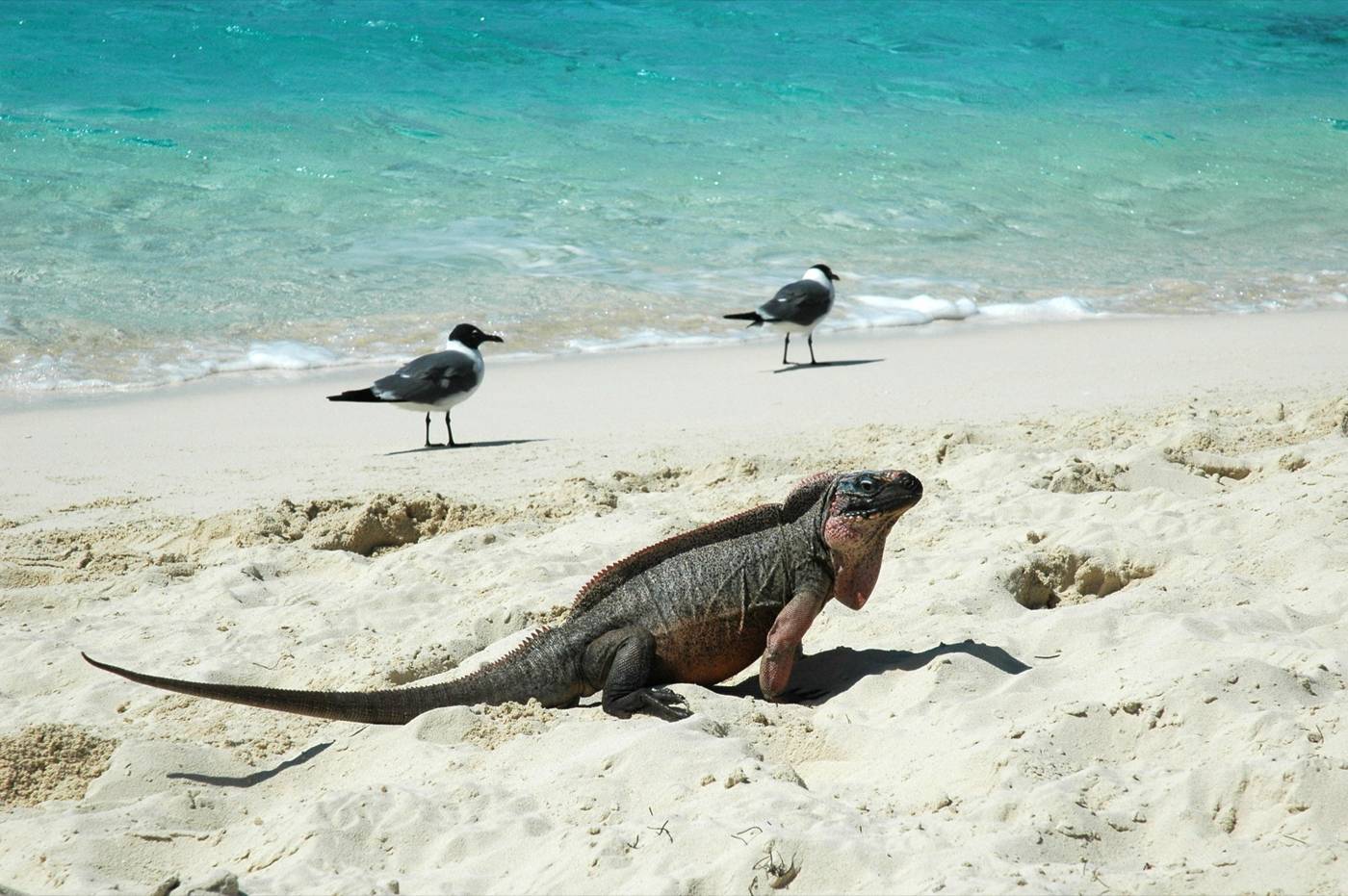
Most of the Exuma Cays Land & Sea Park is water, yet its land is a vital refuge for a small mammal called the hutia, several rare iguana species and marine birds such as terns and white-tailed tropicbirds3. Below is what lives there, and what the park asks of you around it. The park hub has the wider picture.
The Bahama hutia
Hutias are nocturnal, and they are the only land mammal native to The Bahamas1. A small population was transplanted to two locations, Little Wax Cay and Warderick Wells1. See Warderick Wells headquarters.
The hutia is protected under the Wild Animals (Protection) Act1. Current populations are thriving, yet the hutia is still considered an endangered species1.
Because hutias are active at night, do not expect to find one on a daytime trail walk. Stay on marked trails and follow the Exuma Park Trail Guidelines6.
Rock iguanas
The endangered Allen Cays rock iguana (Cyclura cychlura inornata) is found on several islands in the Exumas4. The Exuma Island iguana is a subspecies of the Northern Bahamian rock iguana and is found only on the Exuma archipelago5.
Several rare iguana species live on the park’s land3, and visitors can observe iguanas in the park2. For the best-known iguana beach, see the Allen’s Cay iguanas guide.
Seabirds and shorebirds
The park has high bird activity2. Several seabirds nest here, including the Sargasso shearwater, the white-tailed tropicbird and the brown noddy, along with six tern species4.
Pets are restricted to beaches only, and they are not allowed on trails or in the brush6. Over the years pets have destroyed bird nesting sites and cost the park rare or endangered species, including rock iguanas and hutia6. Keep a dog on a leash no longer than 6 feet and never tie it to a tree, bush or table6.
Turtles and fish
Visitors can observe birds, fish, turtles and iguanas in the park2. Underwater, the park has coral reefs, mangroves and seagrasses2. The park’s waters have been managed as a no-take reserve since 1986, which let commercially important queen conch, Nassau grouper and spiny lobster thrive3.
Fishing, conching, shelling and lobstering are all banned, and nothing living or dead may be removed6. The no-take zone guide explains the rule and the penalty: fines and confiscation of vessels6.
Protecting their habitat
Wardens and Defence Force officers stationed at Warderick Wells patrol and watch over the park constantly2. Three Defence Force officers are posted at park headquarters to help park staff with enforcement2. The park is the most visited national park in The Bahamas2, so the rules below apply to every visitor.
Trash disposal is not available in the park, so take out everything you bring in6. Open fires and fireworks are not permitted6. Anchoring is not permitted on coral reefs or in the mooring fields6.
On the water, all vessels, dinghies and jet skis included, run at idle speed in any mooring field or anchorage6. Jet skis stay at least 300 yards off any moored or anchored vessel6. The north tidal creek on Shroud Cay is a strict idle speed, no-wake zone, and motorized vessels may not enter the other tidal creeks there6.
How to treat the animals
The rules that protect wildlife are short6:
Captive wild species, whether native or non-native, and barnyard animals are prohibited from park property6.
Pets are restricted to beaches only. No pets are permitted on trails or in the brush6.
Do not bring captive wild animals or barnyard animals into the park, and do not take anything out. The park office keeps hours of Monday to Friday 9am to 5pm and Sunday 9am to 12pm2, and the office sits on a remote small island, so a call can take time to get through2. Channel 16 is monitored 24 hours a day for emergencies2. Report poaching or other unusual activity to the park office by calling “Exuma Park” on VHF channel 092. The full rule list is on the park rules page.
Read next
Exuma Cays Land & Sea Park rules: what boaters and visitors must follow
The Exuma Cays Land & Sea Park rules in one list: no-take zone, anchoring, speed limits, trails, pets, camping, fires, drones, trash and how to report poaching.
parkExuma Park no-take zone: what it bans, why it exists and how to report poaching
Fishing, conching, shelling and lobstering are banned in Exuma Cays Land & Sea Park. What the no-take rule covers, the penalties, and how to report poaching.
placesAllen's Cay iguanas: how many are left, where they are and how to visit
Allen's Cay rock iguanas are critically endangered, about 1,000 live on three small islands, and the cay is north of Exuma Park. Location, law and visiting.
Questions people ask
Are there iguanas in the Exumas?
Yes. The endangered Allen Cays rock iguana lives on several islands in the Exumas4. The Exuma Island iguana is a subspecies of the Northern Bahamian rock iguana and is found only on the Exuma archipelago5.
What animals live in Exuma Cays Land and Sea Park?
The Bahamas National Trust lists birds, fish, turtles and iguanas2. The park's land is also a refuge for the hutia, several rare iguana species and seabirds such as terns and white-tailed tropicbirds3.
Sources (6)
- Bahama hutia (BNT sheet, PDF)BNT
Bahamas National Trust · bnt.bs · checked 2026-10-18 - Exuma Cays Land & Sea ParkBNT
Bahamas National Trust · bnt.bs · checked 2026-10-18 - Exuma Cays Land and Sea Park in The Bahamas
The Nature Conservancy · nature.org · checked 2026-10-18 - Exuma Cays Land and Sea Park
Wikipedia · en.wikipedia.org · checked 2026-10-18 - Exuma Island Iguana
Zoo Zurich · zoo.ch · checked 2026-10-18 - Exuma Cays Land and Sea Park Rules (PDF)BNT
Bahamas National Trust · bnt.bs · checked 2026-10-18
Photo credits (1)
- Jpatokal / Wikimedia Commons · CC BY-SA 4.0 · source

Park fees and rules come from the Bahamas National Trust or the Bahamas government; check them again before you go. How we check facts.